A Guide to Fractional CFO Services in 2025
A Guide to Fractional CFO Services in 2025

Many startups and portfolio companies are increasingly turning to fractional CFO services as a strategic solution to their financial leadership needs. Private Equity sponsors have found this to be a cost-effective means for delivering a tailored solution to their need for strategic financial leadership within their PortCos. This detailed guide explores everything you need to know about fractional CFOs, from when to hire one to what they cost.
How to Get the Best Fractional CFO Help
When Does Your Company Need a Fractional CFO?
What to Look for in a Fractional CFO
What Should a Fractional CFO Do at a PortCo?
Top Problems that Fractional CFOs Help With
What Qualifications Do Fractional CFOs Have?
Is a Fractional CFO Worth It?
What Do Fractional CFOs Cost?
How to Hire a Fractional CFO for Your PortCo

How to Get the Best Fractional CFO Help
Finding the right fractional CFO requires a clear understanding of your company’s needs and a structured approach to vetting candidates. Start by defining specific objectives, whether it’s raising capital, implementing financial systems, or strategic planning. Look for professionals with experience in your industry and growth stage. Consider working with a top CFO search firm or other platform that pre-vet their professionals and can match you with the right expertise.
Have a role you'd like to discuss?
Looking to expand your team?
When Does Your Company Need a Fractional CFO?
While the decision will always depend on the company, the following are key indicators that it’s time to bring in a fractional CFO
- Revenue reaches $1-5 million annually: As revenue increases, so does the need for strategic financial leadership. A traditional accountant or occasional help from an interim CFO may no longer cut it.
- Planning for a funding round or exit: This is one of the most common reasons for bringing in a fractional CFO.
- Experiencing rapid growth or scaling challenges: Difficult scaling challenges and preparing the groundwork for inorganic growth are common reasons for turning to a fractional CFO.
- Need for sophisticated financial modeling and forecasting: While an accountant or controller may be helpful for closing the books, they often have less experience in complex modeling than an experienced fractional CFO.
- Need for Capital: As a company seeks outside sponsors, whether through venture capital, private equity or via loan, financial reporting requirements often become much more complex. A fractional CFO can provide the support necessary to secure this funding.
What to Look for in a Fractional CFO
All CFOs worth their salt have excellent financial acumen, a demonstrated track-record of financial leadership, excellent modeling and analytical skills, and a superior strategic mindset. In addition to these basic considerations, the ideal fractional CFO should possess:
- Relevant industry experience, particularly in your company’s stage and sector
- Strong track record of successful strategic financial leadership
- Experience with similar-sized companies and growth trajectories
- Excellent communication skills and ability to translate complex financial concepts
- Proven ability to build and lead teams
- Technical expertise in modern financial tools and systems
- Understanding of both operational and strategic finance
What Should a Fractional CFO Do at a PortCo?
A fractional CFO at a portfolio company should be laser-focused on establishing robust financial systems, driving strategic planning, and providing the transparency that both management and investors need to make informed decisions. They need to wear multiple hats – from implementing proper financial controls and reporting structures to guiding fundraising efforts and identifying operational inefficiencies that can boost the company’s bottom line.
Beyond just managing the numbers, a successful fractional CFO serves as a trusted business partner who can translate financial insights into actionable recommendations that accelerate the company’s path to profitability and growth.
Here is a list of a fractional CFO’s typical responsibilities:
- Developing and implementing financial strategy
- Creating robust financial planning and analysis (FP&A) processes
- Managing relationships with investors and board members
- Establishing KPIs and reporting frameworks
- Optimizing cash flow and working capital
- Leading fundraising efforts and due diligence
- Implementing financial controls and systems
- Providing strategic guidance to the executive team
Top Problems that Fractional CFOs Help With
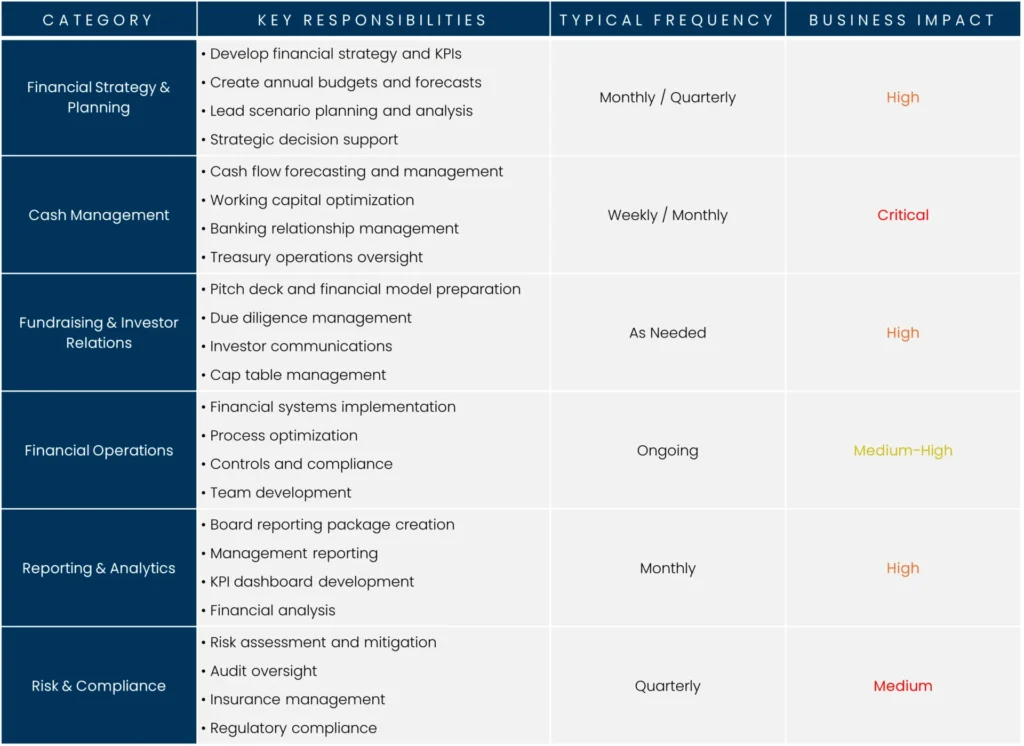
Fractional CFOs address a range of problems, depending on the company and the business environment. Even in the worst financial straights, a fractional CFO can often save the day by swooping in and unraveling a tough financial knot. Whether you’re drowning in cash flow spreadsheets, stressing about your next fundraising round, or trying to figure out how to explain those numbers to your board, these finance pros have got your back. They’re masters at juggling all the money stuff you’d rather not deal with, from setting up solid financial systems to helping you make smart decisions about your company’s future. I’ve included a visual that shows just how many hats these CFO heroes wear!
Not all these responsibilities occur with the same frequency nor are they of the same priority for the business (although all are critical in the long term). Here is a table outlining the frequency and impact of the core responsibilities of a fractional CFO:
What Qualifications Do Fractional CFOs Have?
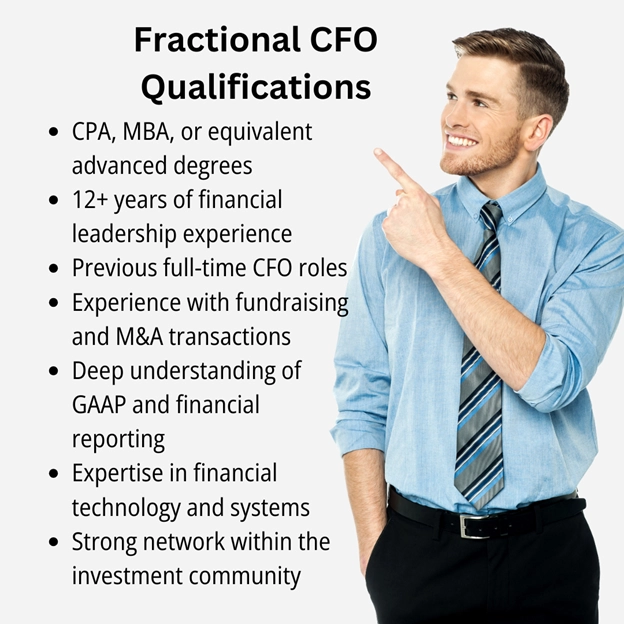
There is no single degree or formal certificate that qualifies someone to be a CFO. Rather, there are core qualifications that most but certainly not all competent fractional CFOs possess. These are:
- Advanced degrees or certifications: CPA, MBA and MS of Finance are some of the most common
- 12+ years of financial leadership experience: Note that not all experience is equivalent. 7 years of experience may be more valuable than 12 if those years were spent in a similar industry or the fractional CFO achieved high success during those years. For example, a turnaround or multiple successful exits at Portfolio Companies can be highly valuable in a fractional CFO.
- Previous full-time CFO roles at successful companies: Because fractional CFOs only spend a portion of their time at the company, they need to be as “plug-and-play” as possible. A fractional CFO should be long enough in the teeth that they can hit the ground running.
- Experience with fundraising and M&A transactions: This will be particularly important if the fractional CFO will prepare for an exit, assist with a bolt-on or roll-up strategy, or contribute in other ways to the company’s inorganic growth.
- Deep understanding of GAAP and financial reporting: This is a basic requirement that all CFOs will have.
- Expertise in financial technology and systems: Depending on the complexity of your organization and its data, the sophistication required here will be variable.
- Strong network within the investment community: This is more important than many people realize when hiring a fractional CFO. Whether it’s a matter of raising funds or learning about your competitors, a fractional CFO with a strong network is a huge boon to any company.
Is a Fractional CFO Worth It?
The value proposition of a fractional CFO depends on your company’s specific needs and stage. Companies often find the investment worthwhile when they:
- Need sophisticated financial leadership but can’t justify a full-time CFO
- Face critical financial decisions or transitions
- Require specific expertise for a particular project or phase
- Want to build a strong financial foundation for growth
- Need to improve investor relations and reporting
If you are considering a fractional CFO, consider also the cost of a full-time CFO. According to salary.com, the average annual salary of a full-time CFO in the United States is $456,739. A fractional CFO, on the other hand, can cost significantly less, as shown below.
What Do Fractional CFOs Cost?
The number one reasons that investors or company leadership seeks a fractional CFO is because it is significantly cheaper than hiring a full-time CFO. Pricing models vary depending on experience of the CFO, geographic location, complexity of the work, length of engagement, and profit-sharing incentives. Fractional CFOs usually charge a minimum of $200-$300 per hour, although top quality CFOs often charge closer to $1000 per hour.
Some CFOs charge monthly, while others might also charge for specific services. For example, some outsourced CFOs will charge a flat flee of around $1000 for performing for month-end financials.
Cost effectiveness comes from flexibility and avoiding full-time executive compensation packages. Even if cash compensation comes in on the high side, companies often save money by paying for limited engagements and avoiding increased costs for insurance, retirement or other benefits usually excluded.
How to Hire a Fractional CFO for Your PortCo
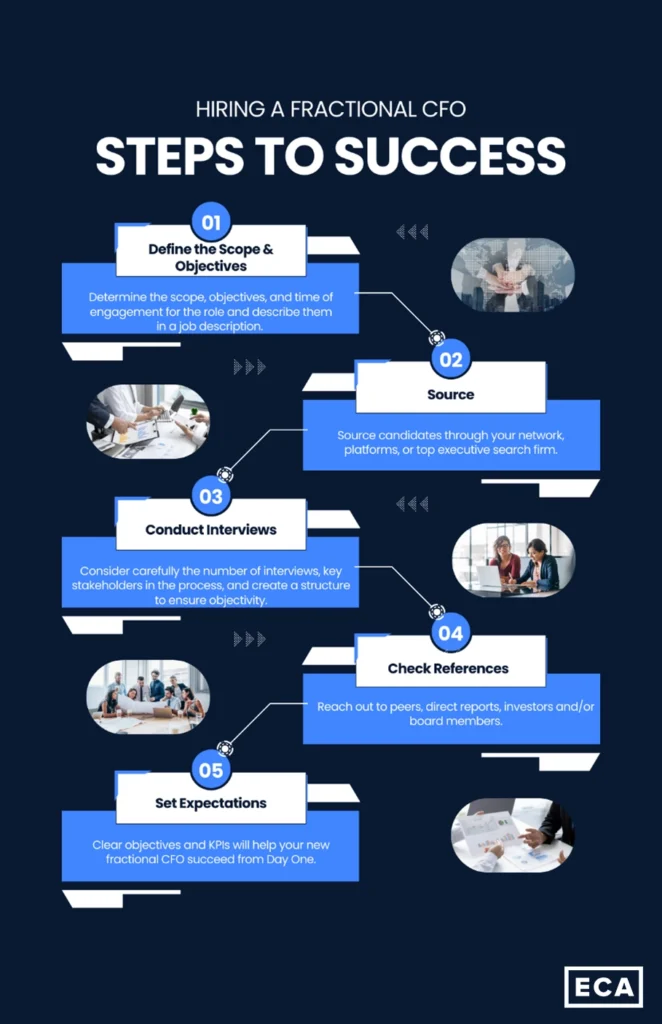
Follow these steps to find the right fractional CFO:
- Define clear objectives and scope of work. This will help you determine your ideal candidate. Also set the desired time commitment and engagement model. Clarity on this early on will help you eliminate candidates who are unable to commit to the required time commitment. Put this information in a detailed job description.
- Source candidates through networks, platforms, or a search firm. Consider using the services of one of these top 5 CFO search firms to ensure best results.
- Conduct thorough interviews focusing on relevant experience. Be sure to consider carefully the number of interview rounds you will conduct with each candidate (too many can lead to a poor candidate experience). Try also to conduct structured interviews to ensure an objective evaluation of each candidate.
- Check references and past performance. For a fractional CFO, this might include C-suite management, board members or investors who have worked closely with them. Consider also reaching out to people who reported to the CFO to get a sense of their ability to manage a team, coach junior members, and build a culture of accountability.
- Set clear expectations and success metrics. Having specific objectives and KPIs from Day One will help you determine the success of the fractional CFO once he is placed in your portfolio company.
Considering fractional CFO services? Read more here about why fractional CFO services are a popular solution for Private Equity and their Portfolio Solutions.
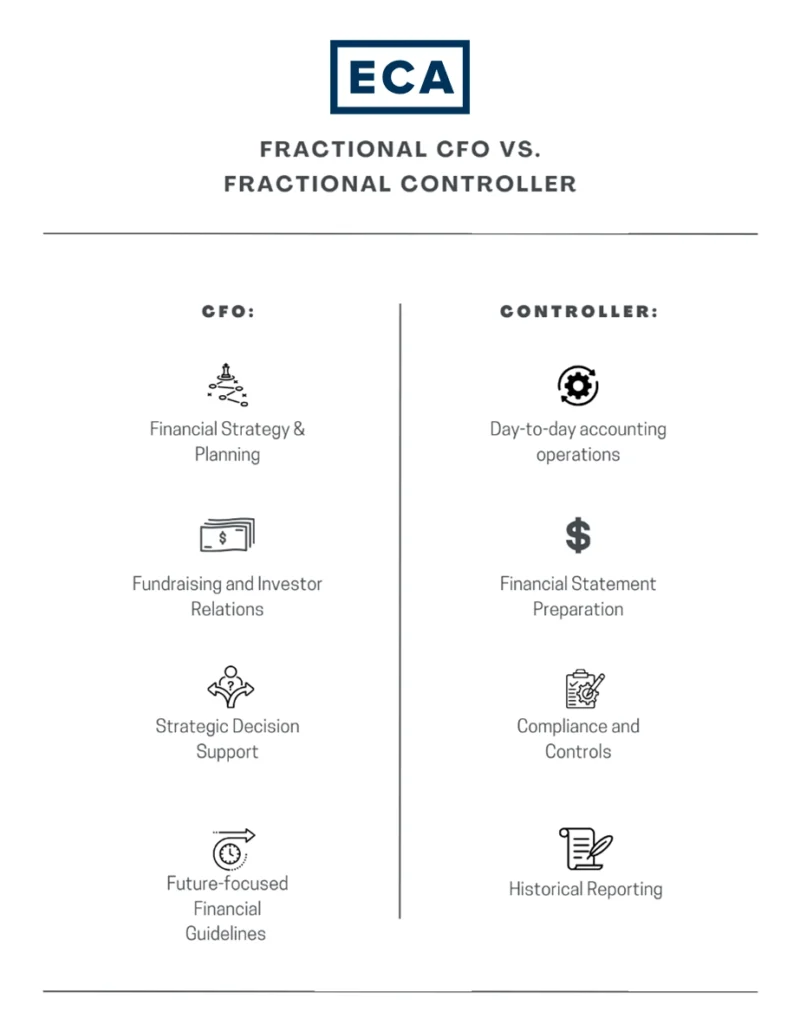
Many companies are unsure if they need the services of an outsourced CFO or a fractional controller. There is a big difference in the responsibilities typically assigned to these to finance leaders. However, generally, CFOs are capable of performing the job of a controller if needed, although the opposite is not always true.
As the table above shows, fractional CFOs are typically more strategic and more focused on the future financial performance of the company. Controllers, on the other hand, typically focus on day-to-day financial operations and the past or historical financial performance of the company.
Consider a controller if you primarily need operational financial management and a CFO if you require strategic financial leadership. Some companies benefit from both, with a full-time controller and fractional CFO working in tandem.
Remember that the right solution depends on your company’s size, stage, and specific needs. Regular assessment of your financial leadership requirements will help ensure you have the right support at the right time.
Steven Haug is a Managing Director at ECA Partners. He can be reached at [email protected].
Expertise
Insights
Commentary & Thought Leadership
Evidence Based RecruitingCase StudiesBlogBeyond Consulting PodcastNot So Private Equity Podcast


