Elective Affinities: Building Portfolio Company Value Creation Teams That Generate Exponential Returns
Elective Affinities: Building Portfolio Company Value Creation Teams That Generate Exponential Returns
In 1809, Johann Wolfgang von Goethe published Elective Affinities exploring how certain elements naturally combine to create something entirely new—more powerful than their individual components. In Goethe's narrative, characters are drawn together by mysterious forces that transcend conscious choice, forming bonds that fundamentally transform all involved. The term "elective" suggests that these affinities involve choice and selectivity—elements don't bond with everything, but only with compatible counterparts that enhance their essential properties. Two centuries later, the most successful private equity firms have discovered that this same principle governs portfolio company value creation teams.
The difference between a portfolio company that delivers 2x returns and one that achieves 5x isn't just strategy or market conditions. It's the elective affinities between team members that create exponential value that transcends individual expertise.
In today's private equity environment, where operational improvements have become the primary lever for value creation, understanding and deliberately engineering these professional affinities has become the ultimate competitive advantage.
The Science Behind Portfolio Company Value Creation Teams
Beyond Individual Excellence
The Four Essential Affinities
Engineering Elective Affinities: Strategic Hiring Approaches
Pre-Assessment: Team Chemistry Mapping
The Sequential Assembly Strategy
Screening for Team Chemistry Indicators
Common Anti-Affinities That Destroy Team Performance
The Expertise Trap
The Cultural Mismatch Syndrome
The Timeline Misalignment Problem
The ROI of Elective Affinities
Quantifiable Performance Improvements
Hidden Value Creation Multipliers
Advanced Team Architecture Strategies
The Portfolio-Level Perspective
Succession Planning for Chemistry Continuity
Conclusion: The Competitive Advantage of Intentional Chemistry

The Science Behind Portfolio Company Value Creation Teams
Have a role you'd like to discuss?
Looking to expand your team?
Beyond Individual Excellence
Traditional approaches to building portfolio company teams focus on collecting high-performing individuals—the best CFO, the most experienced CRO, the most innovative CTO. But exceptional individual performers don't automatically create exceptional teams. As detailed in Evidence-Based Recruiting by Atta Tarki, successful team building requires systematic approaches that go beyond individual credentials to understand collaborative potential.
The most successful portfolio companies exhibit what we call "team synergy"—where team members' complementary strengths create outcomes that exceed the sum of their individual capabilities. This isn't coincidental; it's engineerable through strategic talent architecture. Let’s take a step back and look at the different kinds of affinities that can emerge between team members.
The Four Essential Affinities
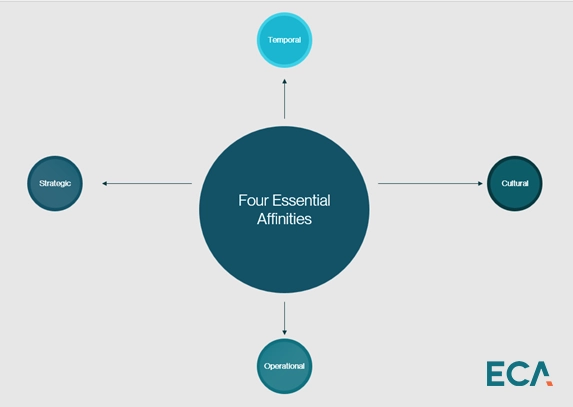
- Strategic Affinity: How team members naturally align on vision and approach to value creation, even when coming from different functional backgrounds.
- Operational Affinity: The intuitive coordination between roles that eliminates friction and accelerates execution velocity.
- Cultural Affinity: Shared values and communication styles that enable rapid decision-making and conflict resolution.
- Temporal Affinity: Synchronized urgency and pacing that matches the portfolio company's stage and the fund's timeline expectations.
Engineering Elective Affinities: Strategic Hiring Approaches
Now let’s see how we can approach the recruitment process in order to best harness these four affinities within the team. We’ll look at initial steps to lay the groundwork for success during your search, a phased approach to hiring you can pursue to capture affinities as your team expands, and ways to screen for team chemistry.
Pre-Assessment: Team Chemistry Mapping
Before adding any new team member, successful portfolio companies conduct "affinity assessments" that evaluate how candidates will integrate with existing team dynamics. This assessment may include:
- Decision-Making Style Alignment: How does the candidate approach complex decisions? Do they complement or conflict with the existing team's cognitive diversity?
- Communication Rhythm Compatibility: Does their communication style enhance team efficiency or create friction points? This goes beyond ensuring the candidate can succeed in the fast pace of a PE PortCo. If communication is clear, proactive, and predicated on an attempt to understand the other’s perspective, you can avoid unnecessary follow-ups and miscommunications.
- Risk Tolerance Calibration: How does their risk appetite align with the team's collective approach to innovation and growth initiatives? This parameter increases in salience if the role is empowered to make executive decisions.
- Execution Velocity Matching: Do they operate at a pace that synchronizes with the team's urgency and delivery expectations? Clear expectations can only get you so far—a dispensation towards executing that complements your own increases productivity and the ability of your team to achieve at a high level.
The Sequential Assembly Strategy
- Phase 1: Establish the Core Triangle: CEO, CFO, and one key operational leader who demonstrate natural collaboration chemistry.
- Phase 2: Add Complementary Strengths: Identify functional gaps and hire specialists who enhance rather than duplicate existing capabilities.
- Phase 3: Integrate Cultural Catalysts: Add team members who strengthen communication, decision-making, and execution velocity across all functions.
- Phase 4: Scale Through Multiplication: Hire additional team members who amplify the established team chemistry rather than diluting it.
Screening for Team Chemistry Indicators
- Collaborative Problem-Solving Assessment: Present candidates with portfolio company challenges that require cross-functional thinking and evaluate their natural inclination toward collaborative solutions.
- Stakeholder Management Evaluation: Private equity environments demand sophisticated stakeholder navigation. Assess how candidates approach complex stakeholder dynamics.
- Change Adaptability Testing: Portfolio companies operate in constant evolution. Evaluate candidates' comfort with ambiguity and their ability to maintain performance during organizational transitions.
- Value Creation Mindset Analysis: Beyond functional expertise, do candidates instinctively think about how their role contributes to enterprise value and exit positioning?
Common Anti-Affinities That Destroy Team Performance
The Expertise Trap
One of the most prevalent team chemistry failures occurs when portfolio companies focus exclusively on assembling functional experts without considering integration capabilities. Over-specialization without integration creates teams composed entirely of deep specialists who excel in their domains but cannot collaborate across functional boundaries. This challenge is compounded by credential competition, where team members compete based on prestigious backgrounds rather than collaborating toward shared outcomes. The result is often siloed excellence—individual high performance that doesn't translate to team achievement due to poor integration and communication between functions.
The Cultural Mismatch Syndrome
Cultural incompatibilities represent another critical threat to team effectiveness. Pace incompatibility emerges when portfolio companies mix team members who operate at fundamentally different speeds or urgency levels, creating friction and missed opportunities. Similarly, communication style conflicts arise when combining direct communicators with indirect communicators without establishing effective translation mechanisms, leading to misunderstandings and delayed decision-making. Perhaps most damaging are decision-making philosophy clashes, where teams include some members who prefer consensus-building while others demand rapid, top-down decisions, creating paralysis during critical moments.
The Timeline Misalignment Problem
Temporal incompatibilities can undermine even functionally strong teams. Short-term versus long-term orientation conflicts occur when team members have incompatible time horizons for value creation initiatives, with some focused on immediate results while others prioritize sustainable long-term growth. Additionally, risk tolerance extremes—combining extremely conservative team members with high-risk personalities without effective risk calibration processes—can create decision-making gridlock that prevents teams from capitalizing on time-sensitive opportunities.
The ROI of Elective Affinities
Quantifiable Performance Improvements
Teams with strong chemistry deliver measurably superior results across multiple dimensions. Research shows that well-aligned teams are 40% more likely to meet project milestones on time, demonstrating accelerated time-to-value that directly impacts fund returns. These cohesive units also exhibit significantly lower rates of strategic initiative failure and operational disruption, providing reduced execution risk that protects invested capital.
From an exit perspective, portfolio companies with integrated leadership teams command premium valuations due to reduced buyer risk perceptions. Finally, operating partners consistently report higher confidence levels and reduced oversight requirements for portfolio companies with demonstrably cohesive teams, creating an investor confidence premium that facilitates additional capital access when needed.
Hidden Value Creation Multipliers
Beyond direct performance metrics, strong team chemistry generates less obvious but equally valuable benefits. Innovation acceleration occurs naturally as teams with strong affinities generate breakthrough solutions more frequently through effective cross-functional collaboration, often discovering opportunities that individual experts would miss.
These high-performing teams also create a talent attraction advantage, becoming magnets for additional top talent and creating positive recruitment cycles that strengthen the entire organization. During challenging periods, crisis resilience becomes apparent as cohesive teams navigate market disruptions and unexpected challenges more effectively, protecting enterprise value when external conditions threaten performance. Finally, scaling efficiency emerges as strong team chemistry enables more efficient organizational growth with reduced management overhead and coordination costs.
Advanced Team Architecture Strategies
As one seasoned operating partner recently told me, "We used to think diversification meant buying companies in different industries. Now we know it means building teams that don't all think the same way." This evolution in thinking has led sophisticated PE firms beyond individual portfolio company optimization toward portfolio-wide team chemistry strategies that multiply value across their entire investment thesis.
The Portfolio-Level Perspective
- Cross-Portfolio Learning Networks: Creating connections between portfolio companies with complementary team strengths to accelerate learning and best practice sharing.
- Talent Pipeline Development: Building relationships with executives who have demonstrated team chemistry across multiple portfolio company environments.
- Operating Partner Integration: Ensuring that operating partner involvement enhances rather than disrupts established team chemistry.
Succession Planning for Chemistry Continuity
- Affinity-Based Succession Planning: Identifying and developing internal candidates who can maintain team chemistry during leadership transitions.
- External Candidate Chemistry Pre-Assessment: Evaluating potential external hires not just for functional capability but for team integration potential.
- Transition Management Protocols: Structured approaches to introducing new team members while preserving existing positive dynamics.
Conclusion: The Competitive Advantage of Intentional Chemistry
In Goethe's novel, elective affinities create transformations that none of the individual elements could achieve alone. The same principle applies to portfolio company value creation teams—the right chemistry doesn't just add value, it multiplies it.
The most successful private equity firms no longer leave team chemistry to chance. They engineer it through systematic approaches to talent selection, team architecture, and chemistry optimization. This isn't just about hiring great people; it's about creating great teams that generate exponential returns through collaborative excellence.
As the private equity industry becomes increasingly competitive and operational value creation becomes the primary differentiator, the ability to build and maintain high-chemistry portfolio company teams represents the ultimate sustainable competitive advantage.
The question isn't just whether your portfolio companies have talented individuals—it's whether those individuals have formed the elective affinities that transform good companies into extraordinary value creation engines.
Evan Metzger is a Project Manager at ECA Partners. He can be reached at [email protected].
Expertise
Insights
Commentary & Thought Leadership
Evidence Based RecruitingCase StudiesBlogBeyond Consulting PodcastNot So Private Equity Podcast


