From Pipes to Profits: The Ultimate CFO Hiring Guide for Plumbing Services
From Pipes to Profits: The Ultimate CFO Hiring Guide for Plumbing Services

The residential plumbing services sector continues to be an attractive sector for PE investment as we enter 2025. With over 120,000 plumbing businesses across the United States—ranging from single-truck operations to sophisticated multi-state platforms—the industry presents both tremendous opportunity while remaining fragmented. Private equity investors have acquired nearly 800 home services companies since 2022, recognizing plumbing's recession-resistant revenue streams and significant consolidation opportunities. This wave of institutional investment has intensified the demand for strategic financial leadership across the sector.
Recent market analysis from the National Association of Plumbing-Heating-Cooling Contractors reveals that the residential plumbing market is projected to reach $158.6 billion by 2029, up from approximately $122 billion in 2024, driven by aging infrastructure, new construction, and evolving consumer expectations. This growth trajectory, combined with the sector's essential nature and fragmented market structure, makes sophisticated financial leadership critical for companies seeking to capitalize on consolidation opportunities or position themselves as attractive acquisition targets.
Why Plumbing Services Benefit from CFO Leadership
The Evolution of Financial Leadership in Plumbing Services
When to Elevate Your Financial Leadership
CFO versus Controller: Making the Right Choice
The Modern Plumbing Services CFO: Essential Competencies
2025 Market Dynamics Shaping Financial Leadership
Maximizing Return on Financial Leadership Investment
Conclusion: Building Financial Excellence for the Future

Why Plumbing Services Benefit from CFO Leadership
Unlike traditional manufacturing or retail businesses, plumbing services companies face distinct financial challenges that require specialized expertise. Research from ServiceTitan’s 2024 State of the Trades Report indicates that 67% of plumbing businesses struggle with cash flow management, while 54% cite unpredictable revenue patterns as their primary financial concern.
The complexity stems from several interconnected factors. Emergency service calls create volatile revenue streams that differ dramatically from scheduled maintenance work. Commercial projects introduce milestone-based billing complications absent in residential work. Equipment costs—from specialized diagnostic tools to fleet vehicles—represent substantial capital investments that must be carefully managed. Additionally, the industry’s reliance on skilled technicians creates unique compensation structures that directly impact financial performance.
Have a role you'd like to discuss?
Looking to expand your team?
The Evolution of Financial Leadership in Plumbing Services
The role of financial leadership in plumbing companies has undergone dramatic transformation over the past decade. According to Deloitte's research on CFO evolution, modern financial executives must balance four critical roles: steward of resources, operator of efficient systems, strategist for growth, and catalyst for organizational change.
In the plumbing services context, this evolution manifests in several ways. Today’s financial leaders must understand the intricacies of field service management software, navigate complex warranty and insurance arrangements, and optimize technician utilization rates. They’re expected to drive digital transformation initiatives while maintaining the personal touch that differentiates successful plumbing businesses.
The Plumbing-Heating-Cooling Contractors Association’s 2024 Leadership Survey found that companies with dedicated financial leadership outperformed their peers by an average of 23% in revenue growth and 31% in EBITDA margins. This performance gap underscores the value of strategic financial leadership in driving operational excellence.
When to Elevate Your Financial Leadership
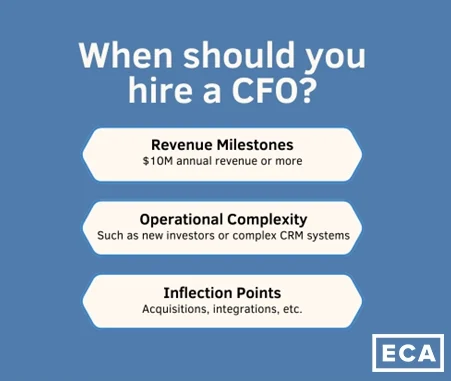
So, when should you hire a CFO? Industry benchmarks suggest several key indicators signal readiness for CFO-level expertise. Consider the following as you consider your decision:
Revenue milestones provide clear markers. According to Bessemer Venture Partners’ CFO Community Survey, companies approaching $10 million in annual revenue typically benefit from dedicated financial leadership, while 37% of respondents indicated that $10-25 million of annual recurring revenue represents the optimal range for bringing on a CFO. CFO Hub’s industry analysis confirms that businesses exceeding $35-50 million almost universally require full-time CFO-level capabilities.
Operational complexity serves as another crucial indicator. Managing mixed commercial and residential portfolios, implementing sophisticated CRM and field service management systems, or navigating equipment financing arrangements all suggest the need for strategic financial oversight. As noted in FMI Corporation’s 2024 Construction Industry Financial Benchmarking Study, companies undergoing digital transformation see 40% better outcomes with dedicated financial leadership.
Strategic inflection points often trigger the need for enhanced financial capabilities. Whether preparing for institutional investment, executing acquisition strategies, or planning for eventual exit, these transitions demand sophisticated financial expertise. The National Center for the Middle Market reports that middle-market companies with professional financial leadership achieve exit multiples averaging 2.3x higher than those without. This reality has become particularly evident as PE-backed platforms execute multi-location rollups, requiring financial leaders capable of managing complex integrations and driving operational synergies.
CFO versus Controller: Making the Right Choice
The distinction between CFO and controller roles often confuses plumbing services executives, yet understanding this difference proves crucial for organizational success. Controllers excel at financial operations, managing day-to-day accounting functions, ensuring compliance, and producing accurate financial statements. They provide the foundation upon which strategic decisions rest.
CFOs, conversely, function as strategic partners to ownership and executive teams. They translate financial data into actionable insights, drive value creation initiatives, and manage external stakeholder relationships. In the context of plumbing services, a CFO might identify acquisition opportunities that complement geographic coverage, while a controller ensures smooth integration of acquired entities’ financial systems.
The Association for Financial Professionals’ 2024 Benchmarking Report indicates that companies with revenues between $10-50 million increasingly adopt hybrid models, combining controller-level operational excellence with fractional CFO strategic guidance. This approach provides cost-effective access to senior financial expertise while maintaining operational continuity.
The Modern Plumbing Services CFO: Essential Competencies
Today’s plumbing services CFO must possess a unique blend of technical expertise, industry knowledge, and leadership capabilities. Technical proficiency remains foundational, encompassing advanced financial modeling, cash flow optimization, and risk management. However, industry-specific knowledge increasingly differentiates exceptional financial leaders from merely competent ones.
Understanding the nuances of service-based revenue recognition, managing warranty reserves, and optimizing technician compensation structures requires deep industry immersion. The Contractor Best Practices Survey reveals that CFOs with prior trade services experience deliver 35% better financial performance metrics within their first year.
Leadership capabilities extend beyond traditional finance functions. Modern plumbing services CFOs must effectively communicate with field technicians, build relationships with equipment suppliers, and present compelling narratives to investors. They serve as cultural bridges between blue-collar operations and white-collar governance, requiring exceptional emotional intelligence and communication skills.
2025 Market Dynamics Shaping Financial Leadership
Several macro trends significantly impact financial leadership requirements in plumbing services. The widespread adoption of artificial intelligence and machine learning in dispatch optimization, predictive maintenance, and customer service creates new responsibilities for financial leaders. As a result, leaders need to keep tabs on technology investments, manage implementation budgets, and quantify operational improvements.
Labor market dynamics present ongoing challenges. With skilled technician shortages projected to worsen through 2030, financial leaders must design creative compensation structures that attract and retain talent while maintaining profitability. The Bureau of Labor Statistics projects 15% growth in plumbing jobs through 2032, intensifying competition for qualified technicians.
Environmental regulations continue evolving, requiring financial planning for equipment upgrades, training investments, and potential business model shifts. Water conservation mandates, chemical handling requirements, and energy efficiency standards all carry financial implications that strategic CFOs must anticipate and manage.
Market consolidation shows no signs of slowing. IBISWorld’s 2024 Plumbing Services Industry Report indicates that the top 50 companies now control 15% of market share, up from 8% just five years ago. This consolidation creates both opportunities and challenges, as smaller operators must choose between selling, competing, or finding niche specializations.
Maximizing Return on Financial Leadership Investment
The impact of exceptional financial leadership extends far beyond improved reporting or compliance. Leading plumbing services companies report transformational outcomes from strategic CFO hires, including 20-30% improvements in gross margins through better job costing and pricing optimization, 40% reductions in days sales outstanding through improved collection processes, and 15-25% increases in technician productivity via data-driven scheduling and compensation redesigns.
Long-term value creation proves even more compelling. Companies with strategic financial leadership consistently achieve higher exit multiples, successfully execute accretive acquisitions, and build sustainable competitive advantages through operational excellence. The Harvard Business Review’s analysis of middle-market value creation demonstrates that financial leadership quality ranks among the top three factors determining exit success.
Conclusion: Building Financial Excellence for the Future
As the residential plumbing services industry continues its rapid evolution, financial leadership emerges as a critical differentiator between companies that merely survive and those that thrive. The convergence of technological disruption, market consolidation, and changing consumer expectations creates an environment where strategic financial leadership provides a decisive competitive advantage.
Organizations that recognize finance as a strategic weapon rather than an administrative function position themselves for exceptional outcomes. Whether building a regional platform, executing a national roll-up strategy, or preparing a family business for institutional investment, the right financial leader serves as catalyst for transformation.
Steven Haug is a Managing Director at ECA Partners. He can be reached at [email protected].
Evan Markgraf is a Senior Director at ECA Partners. He can be reached at [email protected].
Expertise
Insights
Commentary & Thought Leadership
Evidence Based RecruitingCase StudiesBlogBeyond Consulting PodcastNot So Private Equity Podcast


