Getting Back to Work Like It’s 1919
Getting Back to Work Like It’s 1919
Normally, when you read through a newspaper that’s over a century old, it’s the passage of time that feels most striking. The language is outdated, and the arrangement of advertisements is completely unfamiliar. That passage of time felt even more profound when you could go to a library touch the old newspapers in-person – as the decades pass, a musky smell builds up and the paper turns leathery, wasting away until it’s finer than tissue paper.
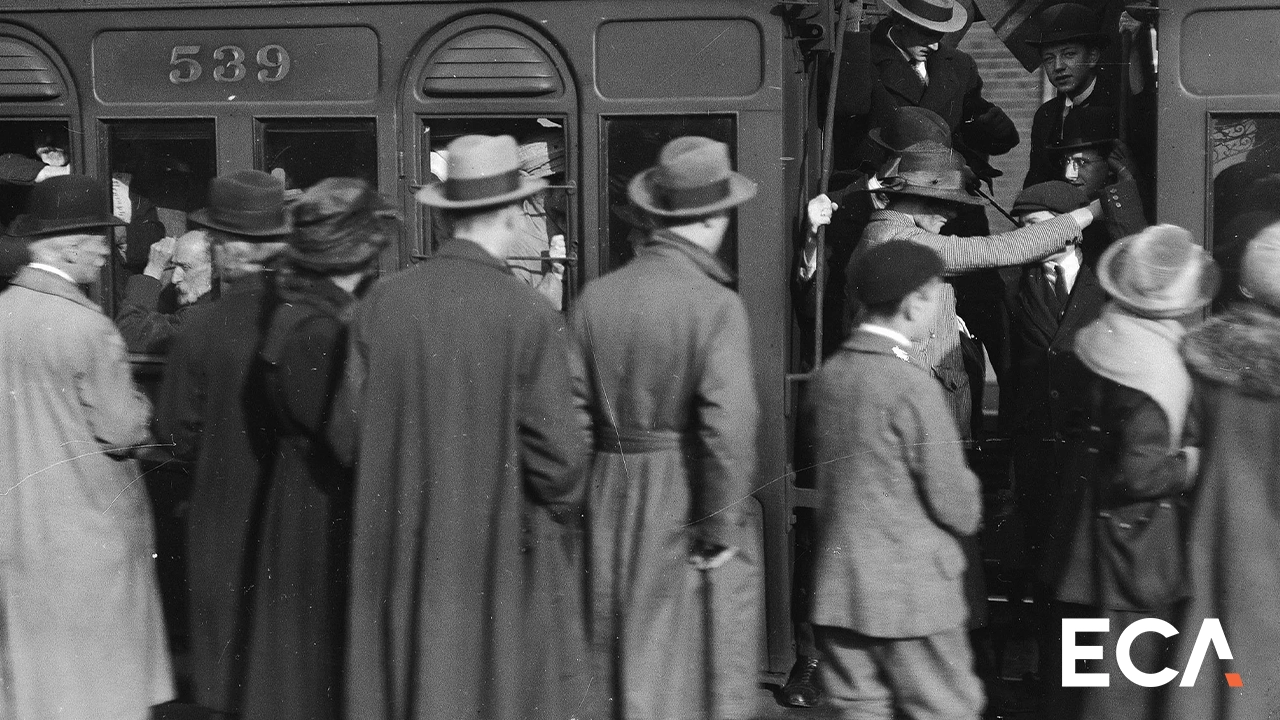
But when it comes to the 1918 flu pandemic, that century-wide gulf collapses. For all the uncertainty that we have all felt throughout these last two years defined by covid, the beat-for-beat parallels between the 1918 pandemic and our current covid-19 moment are striking. To take one example, look at the way that the influenza pandemic data was visualized in the Los Angeles Times. All that separates the figure from the ones we’ve seen on the landing page of the New York Times for the past two years is its hand-drawn quality.

Think of a covid-related issue, and there will almost certainly be an influenza headline from 1918 evidencing how that drama played out before:
Resistance to masks? In a conference called by the mayor of Los Angeles on 7 November 1918, commissioners, doctors, and industry representatives debated whether a mask mandate should be enforced. The Los Angeles Times hashed out the stakes: if mask wearing was imposed, would the city open back up to “theater-going, church services and school sessions”? How much credence should be given to the vocal minority of doctors, who claimed that masks were counter-productive to public health because they would merely trap in dirt and germs?
Protests against closures? During the same month, the Merchants and Manufacturers Association filed a “vigorous” protest against the closing down of all businesses for five days. The representatives complained that their interests were being harassed, and the measures would only stoke “commercial panic.”
Wedding season in turmoil? On 9 October 1918 the Washington Post recalled the invites to Mrs. Bryant’s and Arthur Herbert’s wedding, announcing that “Because of the epidemic of influenza the wedding will be private.”
The point in drawing these parallels is that we can still learn from past experiences. We are currently in a moment where (fingers crossed) the worst has passed, and the most pressing covid questions concern the processes by which the world returns to work. Of course, there are some critical differences between today and the 1918 pandemic: it was notably shorter, and remote work was far less feasible. But what survives over that century divide is a craving to get back to “normality,” mediated by deeper observations that the pandemic experience might have changed our habits indelibly.
On 1 December 1918, the Los Angeles Times published an article under the headline “Adios, ‘Flu’ Scare!” The author complained ardently that the city had “suffered woefully from overregulation” in comparison to other large cities. It was time, they implored, to “forget it” and “get back down to business.”
One key takeaway is that we shouldn’t be too surprised at the stop-start nature of the return to work. While by February 1920 the LA Times could confidently print the headline “Flu Situation Still Normal,” that same issue detailed how the city of Fresno had closed its theaters, poolrooms, schools and churches (apparently, in that order). Boston, on that same day, was experiencing its worst figures of the entire pandemic.
Another portent is that going back to work will involve the adaption of practices, and that there will be long-term debate over where responsibility for safety falls between private institutions and public bodies. In late December of 1921, nearly two years after the worst of the pandemic had hit, the Washington Post was still applauding the government for the active measures it was taking to ensure that steamship companies adopted “the necessary sanitary measures” on the “other side of the ocean.” The State Department refused to provide clean bills of health to any boat that did not have reasonable facilities for “thoroughly cleansing and disinfecting the persons as well as the clothing and other belongings of their steerage passengers.”
A slightly more depressing, if not surprising, final note is that the waning of the pandemic did not bring about any resolution or profound reconciliation on the public health measures that had been enforced. The pages of the newspapers during 1920 and 1921 were dominated by passionate debates about the efficacy of masks. If the past is any indication there, we’ll be stuck with that conversation for a while yet…
Olivia Humphrey is a Project Manager at ECA. She can be reached at [email protected]
Have a role you'd like to discuss?
Looking to expand your team?
Expertise
Insights
Commentary & Thought Leadership
Evidence Based RecruitingCase StudiesBlogBeyond Consulting PodcastNot So Private Equity Podcast


