How to Hire the Right CFO for Your Multi-Site Healthcare Organization: A Strategic Guide for 2025
How to Hire the Right CFO for Your Multi-Site Healthcare Organization: A Strategic Guide for 2025
It’s no secret that the multi-site healthcare sector is undergoing rapid transformation. With increasing private equity investment and heightened regulatory scrutiny shaping the landscape, securing a CFO with healthcare-specific expertise is pivotal to gaining a competitive edge. As private equity firms deploy complex portfolio optimization strategies, they require financial leaders whose scope far exceeds traditional functions. That is why today’s healthcare CFOs serve as critical value creators—designing operational efficiency frameworks, orchestrating strategic acquisitions, and making capital allocation decisions that drive sustainable enterprise value and optimize returns.
Finding a CFO uniquely attuned to the intricacies and economic dynamics of multi-site healthcare assets is no simple task. To help demystify this process, this guide clarifies the financial and operational challenges healthcare systems face, defines the ideal CFO profile, and offers a roadmap to recruit a top-tier, impact-driven healthcare CFO.
Why Hiring the Right CFO Matters in Multi-Site Healthcare
Understanding the Unique Financial Complexities of Multi-Site Healthcare
Key Qualifications to Look for in a CFO Candidate
Deep Healthcare Finance and Multi-Site Experience
Advanced Technical Expertise in Healthcare Financial Management
Strategic Vision Aligned with Healthcare Growth and Compliance
Comprehensive Regulatory, Compliance, and Risk Management Expertise
Educational Background and Certifications
Best Practices for Recruiting Your Healthcare CFO in 2025
Setting Your Healthcare CFO Up for Success: The First 90 Days
Common Pitfalls to Avoid
Conclusion

Why Hiring the Right CFO Matters in Multi-Site Healthcare
A CFO in a multi-site healthcare system plays a far-reaching role beyond traditional financial management. According to the 2025 BDO Healthcare CFO Outlook Survey, 57% of healthcare CFOs plan strategic transactions or partnerships this year, emphasizing the CFO’s role in growth and transformation initiatives. Moreover, Deloitte’s 2025 US Healthcare CFO Survey highlights that CFOs are more focused than ever on bridging the gap between finance, strategy and operations in order to drive value within a complex regulatory environment.
Have a role you'd like to discuss?
Looking to expand your team?
Understanding the Unique Financial Complexities of Multi-Site Healthcare
Multi-site organizations face operational and financial challenges distinct from single-location providers. With this in mind, your CFO must be equipped to handle:
- Diverse Revenue Streams: Outpatient, inpatient, and ancillary services all require tailored billing and revenue cycle strategies. Therefore, mastery of healthcare accounting rules (including GAAP, FASB ASC 606) and payer mix optimization is essential.
- Regulatory Complexity: Heightened scrutiny from CMS, OIG, and private insurers means rigorous reporting, audit readiness, and proactive risk management.
- Capital Allocation at Scale: Investment decisions span EHR upgrades, facility expansions, and clinical integration across sites. As a result, data-driven capital planning is key.
- Disparate Operations: Patient demographics, payor mixes, and staffing models can vary dramatically across sites, demanding local nuance in financial planning.
- Labor Costs: With wages forming the largest line item, a Multi-Site Healthcare CFO must balance productivity initiatives with quality-of-care imperatives.
Hiring the wrong CFO can set a healthcare organization back significantly, but the right one transforms your future. According to Deloitte Insights, a top-tier CFO not only masters complex reimbursement for Medicare, Medicaid, and commercial payors, but also keeps your organization compliant with ever-changing regulations.
They also drive investments in technology and facilities that improve patient access, seamlessly connect executive leadership with frontline teams, and consistently find new ways to improve operational efficiency and control costs. With a strong CFO at the helm, your organization is poised to thrive in today’s demanding healthcare landscape.
Key Qualifications to Look for in a CFO Candidate
Deep Healthcare Finance and Multi-Site Experience
First and foremost, your CFO must have a proven track record managing financial operations across multiple healthcare facilities, including hospitals, outpatient clinics, and specialty units. They should understand diverse healthcare delivery models such as fee-for-service, value-based care, and capitated payment systems. Also essential is experience with payer mix variability and consolidating financial reporting across sites.
Advanced Technical Expertise in Healthcare Financial Management
The ideal CFO must have mastery of healthcare accounting standards, cost accounting tailored to service lines, and fund accounting where applicable. Unless you have a dedicated RCM specialist, they should be well-versed in reimbursement methodologies like MS-DRGs and bundled payments. Proficiency with healthcare IT platforms, EHR integration, and revenue cycle management software is critical to optimize billing and cash flow management.
Strategic Vision Aligned with Healthcare Growth and Compliance
CFOs didn’t used to be thought of as visionary leaders. Today, candidates must demonstrate the ability to formulate financial strategies that balance cost control with investments in patient safety, quality improvement, and technology innovation. Experience in mergers, acquisitions, capital budgeting, and aligning financial incentives with clinical outcomes is highly valuable.
Comprehensive Regulatory, Compliance, and Risk Management Expertise
A solid understanding of healthcare laws — including HIPAA, Stark Law, Anti-Kickback Statute, Medicare Conditions of Participation, and state licensing — is mandatory. The CFO should have experience implementing controls to prevent fraud, managing reimbursement audits, and ensuring alignment with accreditation standards.
Educational Background and Certifications
A minimum of a bachelor’s degree in Accounting, Finance, or Healthcare Administration is required; advanced degrees (MBA, MHA) are preferred. Relevant certifications such as CPA, CMA, CHFP, or a healthcare-focused CFA enhance candidacy, showcasing specialized expertise.
Best Practices for Recruiting Your Healthcare CFO in 2025
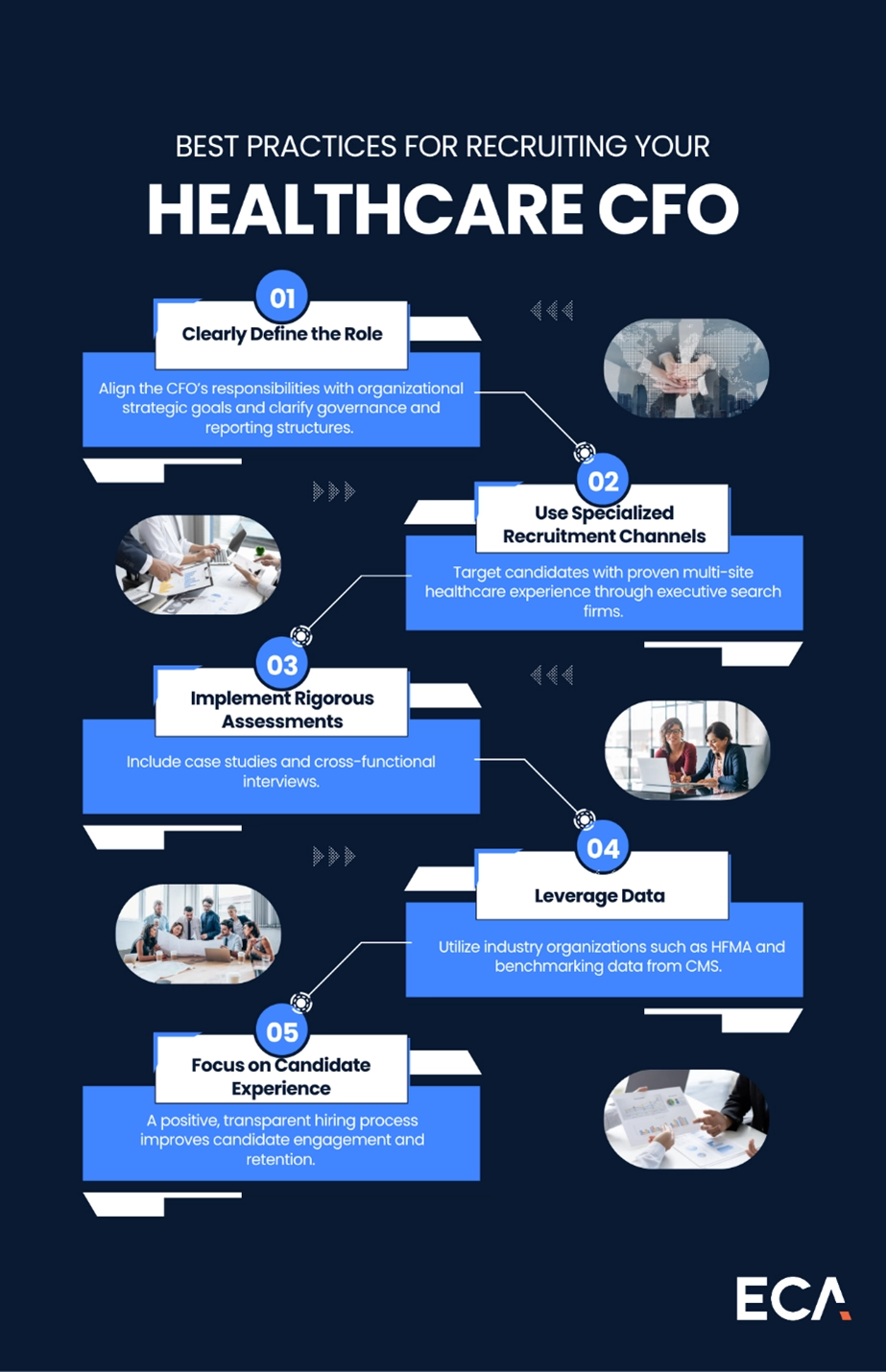
- Clearly Define the Role: Align the CFO’s responsibilities with organizational strategic goals (growth, technology adoption, multi-site integration) and clarify governance and reporting structures.
- Use Healthcare-Specialized Recruitment Channels: Target candidates with proven multi-site healthcare experience through executive search firms like ECA Partners specializing in healthcare and tailored job boards.
- Implement Rigorous and Relevant Assessments: Include case studies on reimbursement optimization, audit preparedness, and cross-functional interviews involving clinical and operational leadership.
- Leverage Data: Utilize industry organizations such as the Healthcare Financial Management Association (HFMA) and benchmarking data from CMS.
- Focus on Candidate Experience and Branding: A positive, transparent hiring process improves candidate engagement and retention.
Setting Your Healthcare CFO Up for Success: The First 90 Days
- Introduce the CFO to key stakeholders, including system executives, site leaders, clinical teams, and payor representatives.
- Conduct thorough reviews of historical financials, compliance audits, and capital projects status.
- Align reporting expectations, communication rhythms, and strategic priorities with the board.
- Identify early wins—cash flow improvements, billing efficiencies, or staffing productivity initiatives.
Common Pitfalls to Avoid
- Selecting candidates without healthcare-specific financial or operational expertise
- Underestimating the importance of cultural fit in a complex clinical environment
- Neglecting collaboration needs between system-level and site-level leadership
- Failing to set realistic timelines for transformational initiatives
Conclusion
The complexity and scale of multi-site healthcare organizations demand CFOs who bring far more than traditional financial expertise. These leaders must skillfully navigate a complex landscape marked by diverse regulations, shifting reimbursement models, and operational challenges spanning multiple locations.
The right CFO acts as a linchpin—integrating financial strategy with clinical objectives, driving efficiency, and enabling growth through informed capital deployment. Identifying such a candidate requires a clear understanding of the unique demands of multi-site healthcare finance and a strategic, targeted recruitment approach. By focusing on the specific qualifications and leadership capabilities outlined in this guide, your healthcare organization can secure a CFO who not only manages financial health but also propels the organization toward sustained success and improved patient care.
Steven Haug is a Managing Partner at ECA Partners. He can be reached at [email protected].
Kylie Thomsen is a Project Manager at ECA Partners. She can be reached at [email protected].
Expertise
Insights
Commentary & Thought Leadership
Evidence Based RecruitingCase StudiesBlogBeyond Consulting PodcastNot So Private Equity Podcast


