Post-Merger Integration Leadership: Hiring the Right Executives to Capture Deal Value
Post-Merger Integration Leadership: Hiring the Right Executives to Capture Deal Value
Private equity firms spend billions on acquisitions each year, yet Harvard Business Review research shows that 70-90% of mergers fail to achieve their projected value, with the breakdown occurring primarily during post-merger integration. For lower middle-market PE firms executing buy-and-build strategies, this failure rate represents millions in unrealized returns.
The culprit is rarely the deal thesis itself. McKinsey research demonstrates that the first 12-18 months post-close have a significant impact on ultimate deal success, with 79% of companies that outperform peers during this period continuing to outperform three years later. Yet most firms lack the specialized leadership to navigate this critical window.
Bottom Line: The difference between an add-on acquisition that delivers projected returns and one that destroys value often comes down to hiring dedicated post-merger integration leadership with the expertise to execute under compressed PE timelines.
Why Integration Fails Without Dedicated Leadership
The Specialized Skill Set of PMI Leaders
When to Bring in Dedicated Integration Leadership
Full-Time vs. Interim Integration Leadership: Making the Right Choice
Full-Time Integration Executives
Interim Integration Executives
Making the Right Choice for Your Situation
Hire Full-Time Integration Leadership When:
Engage Interim Integration Leadership When:
The ROI of Getting Integration Leadership Right
Building Integration as a Repeatable Capability
Take Action: Assess Your Integration Leadership Needs

Why Integration Fails Without Dedicated Leadership
When PE firms close an add-on acquisition, the reflexive move is to task existing portfolio company leadership with integration. This approach fails more often than it succeeds because running steady-state operations requires fundamentally different capabilities than integrating acquisitions.
According to McKinsey, 60% of acquirers regret not dedicating more resources to culture and change management during integration. Your platform CEO who excels at hitting quarterly targets may be completely unprepared for the simultaneous challenges of combining IT systems, harmonizing compensation, consolidating facilities, retaining key talent, and capturing cost synergies—all while maintaining business continuity.
The cost compounds quickly. Delayed integration timelines erode returns. Cultural clashes drive away acquired talent. Customers sense instability and defect. Cost synergies remain unrealized quarter after quarter. Before long, what looked like a strategic bolt-on becomes a value-destroying distraction.
Have a role you'd like to discuss?
Looking to expand your team?
The Specialized Skill Set of PMI Leaders
Post-merger integration isn't simply good general management applied to a new context. It's a specialized discipline requiring distinct capabilities:
- Integration Velocity: PMI leaders operate with aggressive timelines while maintaining thoroughness. They understand that in PE timeframes, a good decision implemented quickly beats a perfect decision implemented slowly.
- Systematic Problem Solving: Integration surfaces hundreds of daily decisions. Effective PMI leaders bring structured frameworks to prioritize by value impact, implementing repeatable processes that prevent decision fatigue.
- Change Management Expertise: Cultural integration is cited by 95% of executives as critical to success, yet 25% identify lack of cultural cohesion as the primary reason integrations fail. PMI leaders must excel at communication, articulating compelling visions while addressing anxiety during uncertainty.
- Cross-Functional Orchestration: Integration touches every function simultaneously. PMI leaders coordinate across finance, operations, sales, IT, HR, and legal, ensuring nothing falls through the cracks.
- Financial Discipline: Everything comes back to value creation. Effective PMI leaders maintain relentless focus on capturing synergies that justified the acquisition, translating operational improvements into financial impact.
When to Bring in Dedicated Integration Leadership
Not every acquisition requires dedicated PMI leadership, but several scenarios demand specialized talent:
- Complex Multi-Site Integrations: Combining organizations with multiple locations or distributed operations increases coordination complexity exponentially. Deciding which facilities to consolidate and how to optimize logistics requires exclusive focus.
- Significant Cultural Differences: Integrating founder-led companies into professionally managed platforms, or combining organizations with different operating philosophies, requires skilled navigation to prevent talent exodus.
- Technology Integration Challenges: Complex IT systems, ERP implementations, and data migrations are notorious for derailing integrations without proper management.
- Multiple Simultaneous Add-Ons: PE firms pursuing aggressive buy-and-build strategies often close multiple add-ons within short timeframes. Without dedicated leadership, these deals overwhelm existing management.
- Underperforming Acquisitions: When acquisitions reveal post-close challenges—declining revenue, at-risk customers, or operational troubles—specialized turnaround-oriented PMI leadership can salvage value and prevent write-downs.
Full-Time vs. Interim Integration Leadership: Making the Right Choice
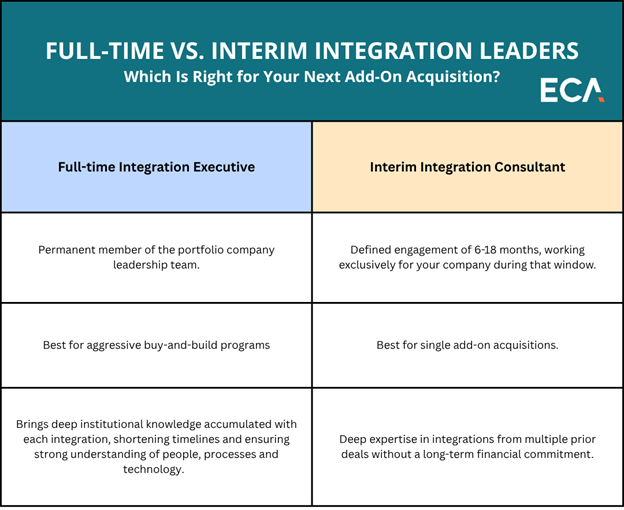
Once you've determined that dedicated PMI leadership is needed, the critical decision is whether to hire a full-time integration executive or engage interim leadership. Understanding the differences is essential to maximizing value while managing costs.
Full-Time Integration Executives
Structure: Permanent member of the portfolio company leadership team with ongoing integration responsibilities
Commitment: Long-term hire, typically with benefits, equity compensation, and career development expectations
Engagement Model: Dedicated exclusively to your organization, becoming part of the permanent executive team
Best For:
- Aggressive buy-and-build programs executing 3-4+ acquisitions annually
- Building integration as a core competency within platform companies
- Positioning portfolio companies as serial consolidators in their industries
- Situations where continuous M&A activity justifies permanent dedicated resources
Advantages: Deep institutional knowledge accumulates with each integration, creating playbooks and processes that improve with each deal. Full-time leaders develop intimate understanding of the platform's culture, systems, and capabilities, accelerating subsequent integrations.
Considerations: Requires significant ongoing investment ($200K-$350K+ annually with benefits). Between integrations, you need sufficient work to keep them productively engaged—often in corporate development, strategic initiatives, or operational improvement projects.
Interim Integration Executives
Structure: Temporary, full-time leadership specifically brought in for the integration period
Commitment: Defined engagement (typically of 6-18 months), working exclusively for your company during that window
Engagement Model: Contracted professionals who step into executive roles with full decision-making authority, then exit when integration is complete
Best For:
- Single add-on acquisitions without near-term follow-on deals planned
- Complex integrations requiring full-time focus but not permanent capability building
- Situations where existing leadership lacks integration experience and needs temporary augmentation
- Transformational acquisitions where integration complexity justifies dedicated full-time resources
Advantages: Brings deep integration expertise from multiple prior deals without long-term commitment. Interim executives typically have specialized experience managing complex PMI, having seen patterns across industries and deal types. Lower cost than permanent hires when integration is time-bound.
Considerations: Higher per-day cost than full-time executives but no long-term obligation. Need to ensure knowledge transfer to permanent team before exit. May require time to build relationships and understand company culture.
Making the Right Choice for Your Situation
The decision framework depends on your M&A strategy and organizational context:
Hire Full-Time Integration Leadership When:
- You're executing multiple deals annually as part of a deliberate consolidation strategy
- Integration capability will be a competitive advantage and value driver long-term
- You have sufficient work between integrations to justify full-time employment
- You're building an M&A-driven platform that will continue acquiring indefinitely
- You want to develop deep institutional integration knowledge over time
Engage Interim Integration Leadership When:
- You're integrating a single significant acquisition without immediate follow-on deals
- Integration is complex enough to require a dedicated full-time focus for 6-18 months
- Your existing management team lacks M&A integration experience
- You want proven integration expertise without long-term commitment
- Budget constraints make permanent executive hiring challenging
The Hybrid Approach: Some sophisticated PE firms use interim leaders for the first 1-2 integrations while simultaneously building internal capability. The interim executive transfers knowledge to platform leadership, creating the foundation for future self-sufficiency. Once the platform team has learned from seasoned professionals, they can handle subsequent integrations with lighter external support.
For most lower middle-market single add-ons, interim integration leadership delivers optimal value—providing executive-level expertise precisely when needed without creating permanent overhead.
The ROI of Getting Integration Leadership Right
Consider a typical LMM add-on: a $50M revenue platform acquires a $15M target at 6x EBITDA, projecting $1M in annual cost synergies and $500K in revenue synergies, fully realized within 18 months.
Without dedicated leadership, synergy capture often falls to 60% of projections. That's $600K of annual EBITDA improvement left on the table. At a 10x exit multiple, that's $6M of unrealized enterprise value. Add integration delays, management distraction, key talent departures, and customer churn, and overall returns can drop 200-300 basis points.
Now consider investing $150-200K in an interim integration leader for 9-12 months. Even improving synergy capture from 60% to 85% creates value multiples of the investment—before accounting for opportunity cost of management time freed to focus on growth rather than firefighting.
For LMM PE firms where every basis point matters, dedicated integration leadership isn't optional. BCG research shows that properly managed post-merger integrations generate 9% more value on average than typical deals, making PMI leadership one of the highest ROI decisions you'll make.
Building Integration as a Repeatable Capability
The most sophisticated PE firms view integration not as a one-time challenge but as a repeatable capability to be systematized. If you're pursuing buy-and-build with multiple anticipated add-ons:
- Create Integration Playbooks: Document your approach to common challenges—IT integration, compensation harmonization, communication templates. Each integration should benefit from prior learning.
- Maintain a Bench of Integration Talent: Develop relationships with interim integration leaders before deals close. When an acquisition closes, you want to activate known resources immediately.
- Build Internal Capability: Even using external interim leaders, ensure knowledge transfer to internal teams. Your platform CFO or COO should improve at integration with each add-on.
- Conduct Integration Retrospectives: After each integration, gather the team for structured debriefs. What worked? What didn't? Capture lessons and incorporate them into your next integration.
Take Action: Assess Your Integration Leadership Needs
If you're planning an add-on acquisition in the next 6-12 months, assess your integration leadership needs now:
- Does our platform management team have experience successfully integrating acquisitions of this size and complexity?
- Based on integration complexity, would interim or full-time leadership create the most value?
- Have we built integration planning into our acquisition timeline, or are we waiting until post-close?
- Do we have relationships with proven integration leaders we could activate when a deal closes?
- What lessons from previous integrations should inform our approach?
The difference between an add-on that delivers projected returns and one that destroys value often comes down to these questions—and the decision to bring in the right leadership at the right time.
Need help identifying post-merger integration leadership for your next acquisition? At ECA Partners, we specialize in placing interim and full-time integration executives for lower middle-market private equity firms and their portfolio companies. Our evidence-based approach ensures you get leaders with proven integration track records—and we move at the speed your deal timeline demands.
Evan Metzger is a Project Manager at ECA Partners. He can be reached at [email protected].
Expertise
Insights
Commentary & Thought Leadership
Evidence Based RecruitingCase StudiesBlogBeyond Consulting PodcastNot So Private Equity Podcast


