Stitched Up with Private Equity: Understanding Value Creation in Fashion and Specialty Retail Acquisitions
Stitched Up with Private Equity: Understanding Value Creation in Fashion and Specialty Retail Acquisitions

Private Equity investments in retail present a fascinating case study in strategic value creation and operational transformation. Recent years have witnessed a significant surge in PE activity within the fashion and specialty retail sector, driven by opportunities for operational enhancement and digital transformation in an evolving consumer landscape. Let’s take a look at the market dynamics that are driving Private Equity’s interest in retail and fashion, and the transformation playbook that many top PE firms are turning to for their retail and fashion PortCos. Finally, we’ll discuss the strategic implications of all this attention to retail from the world of Private Equity.
Market Dynamics and Strategic Positioning
Operational Transformation: A Multi-Faceted Approach
Strategic Considerations and Market Positioning
Looking Forward: Strategic Implications

Market Dynamics and Strategic Positioning
First, let’s consider why Private Equity investors are increasingly interested in retail and fashion. The reason for this is that the retail sector’s structural transformation has created unique opportunities for sophisticated investors. Consider some of the most notable transactions in recent years, which reflect this strategic calculus: Sycamore Partners’ calculated acquisition of Ann Taylor and LOFT, TPG’s strategic position in J.Crew, and CVC Capital Partners’ luxury sector play with Breitling. These investments are evidence of an acute awareness of brand equity’s role in value creation, particularly in markets experiencing significant digital disruption.
In fact, 2024 witnessed a number of high-profile PE investments in major fashion and retail brands, including Sycamore Partner’s investment in Chico’s and Brookfield’s deal to invest in Express.
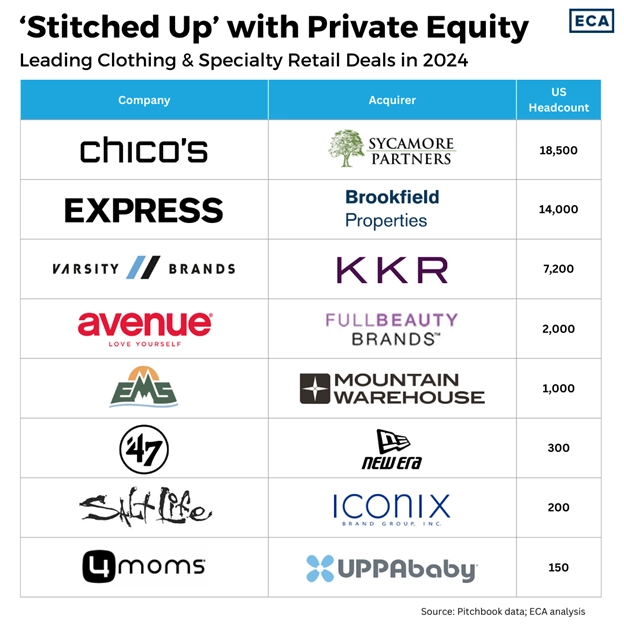
Many investors point to the higher rate of return in retail and fashion than other sectors or the perduring value of assets with high brand recognition. However, many PE firms have noticed an opportunity to increase the value of these assets through both operational and digital transformation initiatives. Let’s take a look at both of these in the context of PE investment in retail.
Have a role you'd like to discuss?
Looking to expand your team?
Operational Transformation: A Multi-Faceted Approach
PE firms typically deploy a comprehensive transformation toolkit in retail acquisitions. The strategic framework encompasses several critical dimensions:
Store Network Optimization represents a primary value creation lever, involving sophisticated geospatial analysis and demographic modeling to optimize retail footprints. This includes strategic lease renegotiations and market penetration assessments, reflecting the evolving nature of physical retail in an omnichannel world.
Supply Chain Enhancement has become increasingly critical in the post-pandemic environment. PE firms are implementing sophisticated vendor management strategies and distribution network optimizations, with particular attention to geographical diversification and lead time reduction – crucial elements in today’s volatile trade environment.
Digital Transformation emerges as a fundamental value driver, encompassing e-commerce platform development, omnichannel integration, and sophisticated customer data analytics. This digital pivot reflects broader structural shifts in consumer behavior and retail economics.
Strategic Considerations and Market Positioning
The current market environment presents unique opportunities for PE firms in retail, particularly in:
- International Expansion: Firms are leveraging sophisticated market entry strategies and partnership models, carefully weighing regulatory requirements against market opportunities.
- Brand Enhancement: Strategic positioning and customer segmentation analysis have become crucial elements in value creation, reflecting the importance of brand equity in driving sustainable returns.
- Organizational Design: PE firms are implementing data-driven approaches to talent management and organizational structure, recognizing human capital’s critical role in retail transformation.
Looking Forward: Strategic Implications
The evolution of PE activity in retail reflects broader structural changes in consumer markets and digital commerce. Successful investors will need to navigate complex operational challenges while maintaining strategic flexibility in an evolving retail landscape. This is especially true as exit strategies for PE remain complicated with public market volatility at a high.
This dynamic environment requires PE investors to keep a close eye on both operational excellence and strategic positioning. There continue to be opportunities for well-executed PE investments in the retail sector. The key to success, however, lies in balancing traditional retail expertise with digital transformation capabilities, while maintaining focus on sustainable value creation through operational enhancement.
Nevertheless, major challenges lie ahead. As more consumers return to in-store shopping after years of Pandemic-driven reliance on e-commerce, a focus on the shopping experience will certainly become more important. Moreover, 2024 showed us that “quiet luxury” brands consistently outperformed other luxury and non-luxury fashion brands (even ones with high brand recognition). It may be that 2025 will see an increase in PE investments in these quiet luxury brands.
Ken Kanara is the President and Managing Partner at ECA Partners. He can be reached at [email protected].
Expertise
Insights
Commentary & Thought Leadership
Evidence Based RecruitingCase StudiesBlogBeyond Consulting PodcastNot So Private Equity Podcast


