The Complete Guide to Hiring Interim CEOs for Private Equity Portfolio Companies in 2025
The Complete Guide to Hiring Interim CEOs for Private Equity Portfolio Companies in 2025
Private equity firms are increasingly turning to interim CEOs as a strategic weapon for portfolio company transformation. With interim executive demand at an all-time high, the question often isn’t whether to consider interim leadership—it's how to deploy it most effectively.
In 2025's challenging market environment, where value creation depends on operational excellence rather than financial engineering, interim CEOs have become the secret to unlocking portfolio company potential quickly and decisively. Let’s take a deep dive into the value these agile operators bring and how you can hire one with maximum efficiency and effect.
Why Interim CEOs Are Critical for Portfolio Companies in 2025
The New Reality of PE Portfolio Management
Key Qualifications for Portfolio Company Interim CEOs
Essential Experience Requirements
Critical Soft Skills
The Strategic Deployment of Interim CEOs
Pre-Investment Due Diligence Support
Post-Acquisition Integration Leadership
Growth and Expansion Management
Exit Preparation Leadership
The Economics of Interim CEO Engagements
Cost-Benefit Analysis
Direct Cost Comparison
Hidden Value Creation
Best Practices for Interim CEO Selection and Management
The Selection Process
Onboarding for Immediate Impact
Performance Management and Accountability
Common Pitfalls and How to Avoid Them
Misaligned Expectations
Insufficient Integration with Operating Partners
Inadequate Cultural Assessment
The Future of Interim CEO Leadership in Private Equity
Technology Integration
ESG and Sustainability Leadership
Global Market Navigation
Conclusion: Interim CEOs as Competitive Advantage

Why Interim CEOs Are Critical for Portfolio Companies in 2025
As we’ve noted previously on this blog, private equity looks radically different than the heady days of 2021-2022. With deal flow rebounding but hold periods extending to record levels, portfolio companies need leadership that can drive immediate impact while preparing for eventual exit. With their agility and ability to deploy within a week, interim CEOs provide exactly this capability.
Have a role you'd like to discuss?
Looking to expand your team?
The New Reality of PE Portfolio Management
Traditional approaches to portfolio company leadership are proving insufficient in today's environment. Interest rate pressures have eliminated cheap leverage, forcing firms to focus on operational value creation. Meanwhile, limited partners are pushing hard for returns on previous investments, creating urgency around portfolio company performance.
This convergence of factors has made interim CEOs indispensable for several critical scenarios:
- Rapid Scaling Requirements: This one’s about all about timing. When portfolio companies experience sudden growth through acquisitions or market expansion, interim CEOs provide the specialized expertise needed to manage complex transitions without missing a beat.
- Transformation Leadership: PE is all about meaningful transformations. A struggling PortCo can benefit from interim CEOs who bring proven track records in change management and value creation.
- Bridge Leadership: During CEO transitions or succession planning, interim CEOs maintain strategic momentum while permanent leadership searches are conducted.
- Crisis Management: When portfolio companies face unexpected challenges—market disruption, regulatory changes, or operational issues—interim CEOs provide experienced leadership without the time lag of traditional executive searches.
Key Qualifications for Portfolio Company Interim CEOs
Not every interim executive can succeed in the data-driven, hard-nosed world of private equity. Portfolio company interim CEOs must possess a unique combination of operational expertise, financial acumen, and adaptability that distinguishes them from traditional interim leaders.
Essential Experience Requirements
- Private Equity Portfolio Experience: The most effective interim CEOs have previously worked in PE-backed environments and understand the unique pressures and expectations. They're comfortable with rigorous reporting requirements, accelerated decision-making timelines, and investor oversight.
- Value Creation Track Record: Look for candidates who have demonstrably improved EBITDA, streamlined operations, or successfully managed exits. Quantifiable results matter more than tenure in the PE environment.
- Industry Specialization: While versatility is valuable, deep sector expertise has become increasingly critical. Healthcare, technology, and manufacturing interim CEOs with specific vertical knowledge consistently outperform generalists.
- Transformation Experience: The best portfolio company interim CEOs have led significant organizational changes—M&A integrations, digital transformations, or operational restructuring—and can articulate their methodologies.
Critical Soft Skills
- Stakeholder Management: Interim CEOs must excel at managing complex stakeholder relationships, including operating partners, board members, management teams, and external advisors.
- Cultural Adaptability: This is often highly undervalued. Portfolio companies often struggle with cultural alignment following ownership changes. Effective interim CEOs can quickly assess and adapt to organizational cultures while implementing necessary changes.
- Communication Excellence: Private equity environments demand clear, frequent communication. Interim CEOs must be exceptional presenters and writers, capable of distilling complex operational data into actionable insights.
The Strategic Deployment of Interim CEOs
Pre-Investment Due Diligence Support
Forward-thinking PE firms are deploying interim CEOs even before closing deals. During due diligence phases, interim CEOs can provide operational assessments that inform investment decisions and post-acquisition strategies.
This approach offers multiple advantages:
- Real-time operational insights that complement financial due diligence
- Early identification of value creation opportunities and potential challenges
- Accelerated post-closing execution when the interim CEO transitions into the role
Post-Acquisition Integration Leadership
As Michael Watkins noted in his renowned book, The First 90 Days, following proven strategies is critical for reaching the “breakeven” point where you start to see the impact of your effort. This is imperative in the first three months following an acquisition. Interim CEOs excel in this environment because they can immediately focus on integration challenges without the learning curve that permanent hires require.
Key integration responsibilities include:
- Management team assessment and optimization
- Operational process standardization
- Financial reporting system implementation
- Cultural integration facilitation
Growth and Expansion Management
When portfolio companies are ready for aggressive growth—through geographic expansion, new product launches, or market penetration—interim CEOs provide the specialized leadership needed to execute complex growth strategies.
Interim CEOs bring growth experience from multiple companies, offering best practices and proven methodologies that accelerate time-to-results.
Exit Preparation Leadership
As hold periods extend and exit markets become more competitive, portfolio companies need leaders who understand what buyers and public market investors seek. Interim CEOs with successful exit experience can position companies for optimal valuations.
This includes:
- Financial process optimization for due diligence readiness
- Management team strengthening to ensure leadership continuity
- Operational efficiency improvements that appeal to strategic buyers
- Growth story articulation that maximizes valuation multiples
The Economics of Interim CEO Engagements
Cost-Benefit Analysis
While interim CEO compensation typically exceeds permanent executive salaries on an annualized basis, the total economic impact strongly favors interim leadership in most portfolio company scenarios.
Direct Cost Comparison
- Interim CEO: Competitive quarterly compensation packages based on company size and complexity
- Permanent CEO: Significant annual compensation plus substantial equity components
Hidden Value Creation
- Accelerated timeline to impact: Interim CEOs typically deliver results within 60-90 days
- Reduced execution risk: Proven track records minimize implementation failures
- Flexibility for strategic pivots: Easy engagement modification as strategies evolve
Best Practices for Interim CEO Selection and Management
The Selection Process
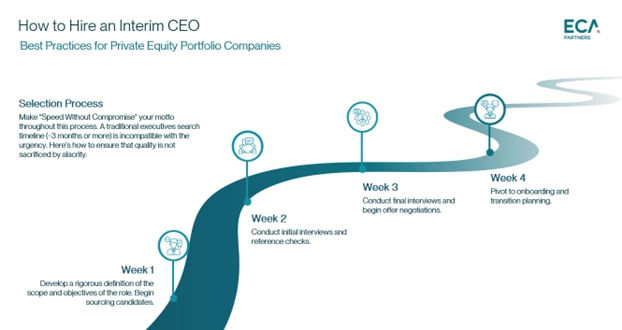
Speed without compromise defines successful interim CEO selection for portfolio companies. Traditional executive search timelines are incompatible with PE urgency, but quality cannot be sacrificed.
Accelerated Timeline Framework
- Week 1: Requirement definition and candidate sourcing
- Week 2: Initial interviews and reference checks
- Week 3: Final interviews and offer negotiation
- Week 4: Onboarding and transition planning
Onboarding for Immediate Impact
Effective interim CEO onboarding focuses on immediate priorities rather than comprehensive orientation. Remember: Onboarding is not just a matter of passing old learnings on to new talent. After all, the idea is to transform the business rather than keep things steady. As J.P. Morgan said, “The first step towards getting somewhere is to decide you’re not going to stay where you are.” So, the key here is to focus on the essential tools and information the CEO will need in order to get somewhere new.
The most successful onboardings include:
- Pre-Start Intelligence Gathering:
- Detailed briefing books covering financials, operations, and strategic initiatives
- Key stakeholder interviews conducted before the official start date
- Access to board materials and investor presentations for context
- First Week Priorities:
- Management team assessments and key hire/retention decisions
- Operational deep dives in critical business areas
- Stakeholder alignment meetings with operating partners and board members
Performance Management and Accountability
Interim CEOs thrive with clear performance metrics and regular accountability checkpoints. The most effective portfolio companies establish:
90-Day Milestone Framework:
- 30 days: Assessment completion and strategic plan presentation
- 60 days: Initial implementation results and team optimization
- 90 days: Performance improvement evidence and next phase planning
Common Pitfalls and How to Avoid Them
Misaligned Expectations
The biggest source of interim CEO engagement failures is misaligned expectations between portfolio companies, PE firms, and interim executives.
Prevention Strategies: Successful engagements require detailed scope definition before engagement begins to ensure all parties understand deliverables and timelines. Equally important are clear success metrics with measurable outcomes that provide objective benchmarks for performance evaluation. Finally, regular expectation calibration through structured check-ins helps identify and address any misalignment before it becomes problematic.
Insufficient Integration with Operating Partners
Interim CEOs must work seamlessly with operating partners to maximize value creation. Successful integrations require:
- Defined role boundaries and decision-making authority
- Regular communication protocols and reporting structures
- Collaborative strategic planning processes
Inadequate Cultural Assessment
Underestimating cultural challenges can derail even the most qualified interim CEOs. Best practices include conducting pre-engagement cultural assessments through management interviews to understand existing dynamics before starting.
Additionally, successful engagements require change management planning with specific cultural initiatives that address resistance and build organizational alignment. Finally, employee communication strategies that build buy-in are essential for ensuring the interim CEO can implement necessary changes without creating unnecessary friction.
The Future of Interim CEO Leadership in Private Equity
Technology Integration
AI and digital transformation capabilities are becoming essential for portfolio company interim CEOs. The most effective candidates bring:
- Digital transformation experience across multiple industries
- Technology assessment capabilities for operational optimization
- Data-driven decision-making methodologies
ESG and Sustainability Leadership
Environmental, social, and governance considerations are increasingly critical for portfolio company value creation. Interim CEOs must understand:
- ESG reporting requirements and investor expectations
- Sustainability initiative implementation and measurement
- Stakeholder engagement around social responsibility
Global Market Navigation
Cross-border complexity requires interim CEOs with international experience. Key capabilities include:
- Regulatory compliance across multiple jurisdictions
- Cultural competency for global team management
- Supply chain optimization in disrupted markets
Conclusion: Interim CEOs as Competitive Advantage
In 2025's challenging private equity environment, interim CEOs represent a critical competitive advantage for portfolio company value creation. Their ability to deliver immediate impact, navigate complex transformations, and prepare companies for successful exits makes them indispensable for modern PE strategies.
The most successful private equity firms treat interim CEO deployment as a strategic capability, not a crisis response. They build relationships with proven interim executives, develop standardized onboarding processes, and integrate interim leadership into their value creation playbooks.
For portfolio companies, the question isn't whether interim CEOs can add value—it's how quickly you can deploy them to capture transformation opportunities and accelerate growth initiatives.
Evan Metzger is a Project Manager at ECA Partners. He can be reached at [email protected].
Expertise
Insights
Commentary & Thought Leadership
Evidence Based RecruitingCase StudiesBlogBeyond Consulting PodcastNot So Private Equity Podcast


