The Rise of Fractional M&A Services
The Rise of Fractional M&A Services

The signs are everywhere: fractional financial leadership is trending. Demand for a fractional Head of M&A, CFO or other financial leadership has doubled in recent years. According to one estimate, two years ago only roughly 2,000 accounts on LinkedIn; today, that number is over 114,000 and quickly rising.
So, what is a fractional Head of M&A, and how can they contribute to your company? In the following, we will discuss what a Head of M&A typically does, why private equity firms are turning to fractional Head of M&A services, and what distinguishes an interim Head of M&A from a fractional Head of M&A. We also provide advice on weighing the pros and cons of a full-time versus fractional M&A leader. Finally, we will discuss how to hire a fractional Head of M&A.
What is a Head of M&A?
Why are Private Equity Firms Considering Fractional Support for M&A Work?
Fractional vs. Interim M&A Leaders
Pros and Cons: Fractional vs. Full-Time M&A Leadership
Cost Structure and ROI
Flexibility and Adaptability
Business Continuity and Knowledge Transfer
Access to Talent
How to Hire a Fractional Head of M&A
1. Calibration & Scoping
2. Candidate Engagement
3. Candidate Evaluations
4. Candidate Selection
5. Onboarding / Kick-off
Putting It All Together…

What is a Head of M&A?
A Head of M&A is a senior executive typically hired by private equity portfolio platform companies pursuing buy-and-build strategies. These strategies represent a form of inorganic growth, which differs significantly from organic growth approaches. While organic growth focuses on expanding a business through internal means such as increasing sales, developing new products, or entering new markets naturally, inorganic growth involves expanding through mergers, acquisitions, and strategic partnerships.
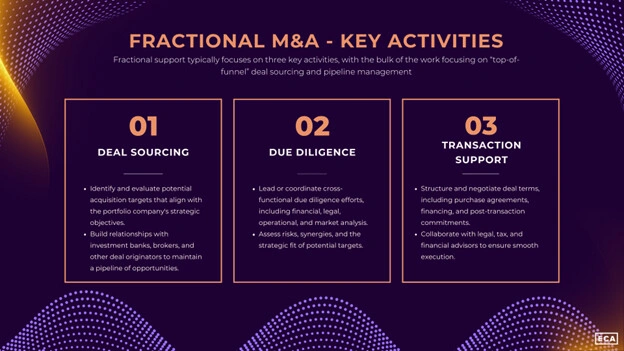
The role focuses on four primary activities:
- Deal Sourcing: Identifying and evaluating potential acquisition targets that align with the company’s strategic objectives.
- Due Diligence: Leading comprehensive evaluations of target companies, including financial, operational, and strategic assessments.
- Transaction Execution: Managing the deal process from initial negotiations through closing, including coordination with legal, financial, and operational teams.
- Integration Support: Facilitating post-merger integration to ensure value capture and synergy realization.
The ideal candidate for this role typically comes from either investment banking or private equity backgrounds, often complemented by consulting experience. This combination of experiences is particularly valuable: investment banking experience provides deep transaction expertise and technical skills essential for deal execution, while consulting experience offers the strategic thinking and operational knowledge crucial for due diligence and post-merger integration.
Typical compensation for a full-time Head of M&A ranges from $200,000 to $350,000 in base salary, with total compensation including bonuses and equity potentially reaching $500,000 to $1,000,000+ annually, depending on the size of the organization and deal volume.
Have a role you'd like to discuss?
Looking to expand your team?
Why are Private Equity Firms Considering Fractional Support for M&A Work?
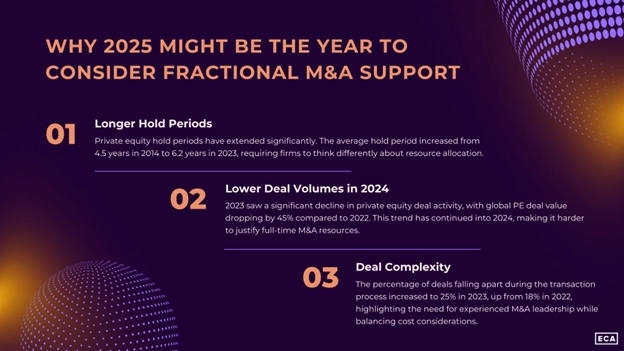
Several market trends are driving the shift toward fractional M&A support:
- Increased Hold Periods: Private equity hold periods have extended significantly. The average hold period increased from 4.5 years in 2014 to 6.2 years in 2023, requiring firms to think differently about resource allocation.
- Decreased Deal Volume: 2023 saw a significant decline in private equity deal activity, with global PE deal value dropping by 45% compared to 2022. This trend has continued into 2024, making it harder to justify full-time M&A resources.
- Higher Deal Complexity: The percentage of deals falling apart during the transaction process increased to 25% in 2023, up from 18% in 2022, highlighting the need for experienced M&A leadership while balancing cost considerations.
Fractional vs. Interim M&A Leaders
You’ve probably heard about fractional and interim CFOs. A similar distinction exists for fractional and interim M&A leaders. This difference is crucial for organizations to understand when seeking flexible executive solutions. The fractional model has emerged as a particularly effective approach for M&A leadership because mergers and acquisitions work naturally aligns with a part-time, extended engagement structure.
Unlike many C-suite roles that require constant presence and daily operational oversight, M&A activities often occur in focused sprints with varying intensity levels throughout the deal lifecycle. This makes the fractional model especially suitable, as it allows organizations to access high-level M&A expertise for a few hours per day or week over an extended period, scaling up or down as needed.
The interim model, while valuable for certain situations, often proves unnecessarily intensive and costly for M&A work. Interim leaders typically step in full-time to fill temporary vacancies or manage specific transitions, which may not align with the natural rhythm of M&A activities, especially in the middle market where deal flow is less constant.
Consider a typical acquisition process: activities like target screening, initial due diligence, and integration planning can often be effectively managed through focused blocks of time rather than requiring full-time attention. This makes the fractional model not just more cost-effective, but often more practical and aligned with actual business needs.

Pros and Cons: Fractional vs. Full-Time M&A Leadership
Not sure if a fractional Head of M&A is right for you? Maybe you are considering a full-time M&A leader instead. The decision between fractional and full-time M&A leadership requires careful consideration of various factors that impact organizational effectiveness and value creation.
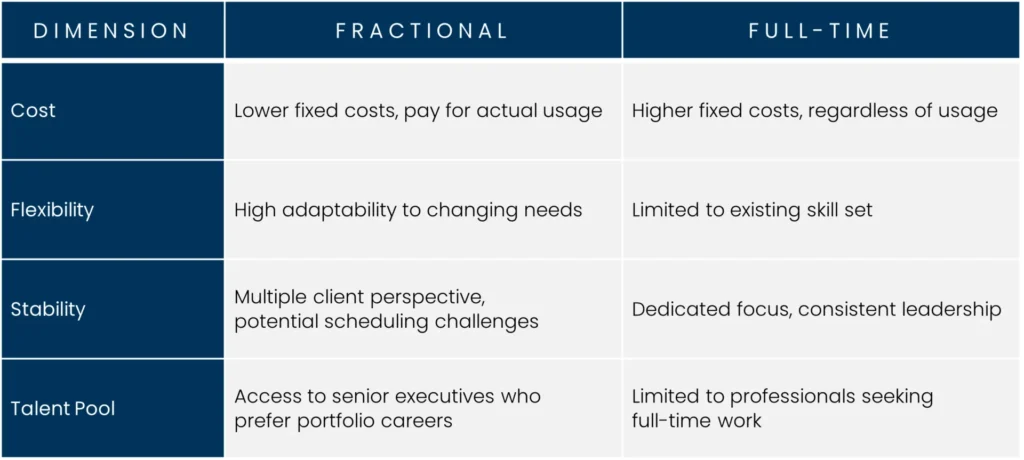
Let’s explore each of these dimensions in detail. We’ve provided a schematic table of each dimension and a detailed description of each below:
Cost Structure and ROI
Fractional leaders typically cost 30-40% of a full-time executive when compared on an annual basis. This cost advantage becomes particularly significant when considering the variable nature of M&A activity. Organizations only pay for the time and expertise they actually need, rather than maintaining a full-time resource during periods of lower deal activity.
Flexibility and Adaptability
Fractional leaders often bring diverse industry experience and best practices from multiple engagements, allowing organizations to tap into a broader knowledge base. They can quickly adapt their involvement based on deal flow and project needs, scaling up during intense periods and scaling back during quieter times.
Business Continuity and Knowledge Transfer
While full-time leaders offer consistent presence, fractional leaders often excel at knowledge transfer and capability building within the organization. They can help develop internal teams and processes, creating sustainable M&A capabilities that persist beyond their engagement.
Access to Talent
The fractional model attracts highly experienced executives who prefer portfolio careers, giving organizations access to talent that might be otherwise unavailable or unaffordable in a full-time capacity. These professionals often bring deeper and more diverse experience than typically available in the full-time market.
How to Hire a Fractional Head of M&A

ECA Partners has developed a comprehensive and sophisticated approach to identifying and placing fractional M&A leaders. This process ensures not just technical fit but also cultural alignment and long-term success.
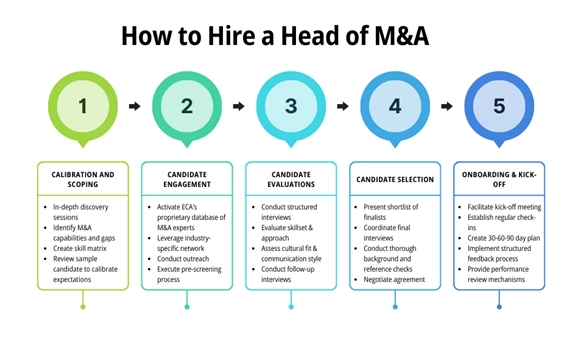
Here’s a detailed look at each phase:
1. Calibration & Scoping
- Conduct in-depth discovery sessions to understand specific business objectives and growth strategy
- Analyze current M&A capabilities and identify specific gaps to be filled
- Define clear success metrics and deliverables for the fractional role
- Create a detailed skill requirements matrix, including both technical and soft skills
- Review sample candidates to calibrate expectations and refine requirements
2. Candidate Engagement
- Activate ECA’s proprietary database of pre-vetted M&A professionals
- Leverage industry-specific networks and relationships
- Conduct targeted outreach to passive candidates with relevant experience
- Execute thorough a pre-screening process focusing on:
- Technical capabilities and transaction experience
- Industry expertise and relevant deal exposure
- Working style and cultural alignment
- Availability and engagement preferences
3. Candidate Evaluations
- Conduct structured video interviews using ECA’s proprietary assessment framework
- Evaluate technical capabilities through case-based discussions
- Assess cultural fit and communication style
- Conduct follow-up interviews with key stakeholders
- Evaluate candidates’ proposed approach to specific business challenges
4. Candidate Selection
- Present shortlist of top candidates with detailed evaluation summaries
- Coordinate final round interviews with key decision-makers
- Conduct thorough background verification process
- Execute professional reference checks focusing on:
- Deal execution capabilities
- Leadership style and effectiveness
- Project management skills
- Communication and stakeholder management
- Assist with engagement structure and agreement negotiation
5. Onboarding / Kick-off
- Facilitate comprehensive kick-off meeting covering:
- Strategic objectives and priorities
- Key stakeholder introductions
- Communication protocols
- Reporting requirements
- Success metrics and milestones
- Establish regular check-in cadence with key stakeholders
- Implement structured feedback process
- Create 30-60-90 day plan for the engagement
- Set up performance review mechanisms
And that’s it! At ECA, we’ve spent years honing this process and developing a network of highly talented M&A leaders. Check out case studies of successful M&A placements here.
Putting It All Together…
Now let’s take a step back and review. As we’ve seen, the world of M&A leadership is undergoing a fascinating transformation, with fractional executives becoming increasingly prevalent in private equity portfolio companies. This shift represents a fundamental rethinking of how companies approach mergers and acquisitions, moving away from the traditional model of full-time Heads of M&A to a more flexible, cost-effective solution.
What’s driving this change? A perfect storm of market conditions has emerged: private equity hold periods have lengthened significantly, deal volume has dropped substantially, and transactions have become increasingly complex. The traditional full-time M&A leadership model simply no longer makes financial sense to a lot of business leaders.
Companies are discovering that fractional M&A leaders can provide high-level expertise at roughly 30-40% of the cost of a full-time executive, while offering the flexibility to scale up or down based on deal flow. For organizations navigating the complex world of mergers and acquisitions, this approach offers a compelling alternative that aligns with the natural rhythm of deal-making, especially in the middle market where constant deal flow isn’t the norm.
The rise of fractional M&A leadership isn’t just a temporary trend – it’s a reflection of how modern businesses are adapting to changing market dynamics and finding smarter ways to access top-tier talent. As we look to the future, this model may well become the new standard for how growing companies approach their M&A leadership needs.
Get ahead of the trend and learn more about our fractional Head of M&A services.
Ken Kanara is the President and Managing Partner at ECA Partners. He can be reached at [email protected].
Expertise
Insights
Commentary & Thought Leadership
Evidence Based RecruitingCase StudiesBlogBeyond Consulting PodcastNot So Private Equity Podcast


