Understanding the Value of Six Sigma Certification in the Recruitment Process
Understanding the Value of Six Sigma Certification in the Recruitment Process
Six Sigma (and Lean Six Sigma) is back in demand as PE-backed manufacturers double down on quality, cost, and throughput. This piece explains what the belt levels really signal—and how recruiters should translate them into proof of process improvement, not just buzzwords. You’ll get quick tips and interview questions to validate hands-on results. If you hire for operations or industrial roles, it’s a concise guide to turning a Six Sigma line on a résumé into real value.

If you work in production, manufacturing, or industrial engineering, odds are that you have heard about the “Six Sigma” or 6σ method. This method refers to a set of organizational tools and skills focused on increasing quality and minimizing inefficiencies. The Six Sigma approach originated out of Motorola engineering in the mid-1980s. The term itself referred to keeping the defect rate in their production process below a sigma level of 3.4 defects per million opportunities. It has since evolved into a set of industry standards for detail-oriented production management and engineering. Six Sigma has also been combined with the Lean approach to create “Lean Six Sigma”, which includes both the waste activity minimization and process efficiency focus of the Lean model and the data-driven efficiency and process alignment protocols of Six Sigma. With a growing number of private equity firms investing in the manufacturing space, we have been seeing an uptick in the number of roles calling for proven experience with process improvement and optimization methods.
From a recruiter’s perspective, it is not always immediately obvious what a Six Sigma certification means on a candidate’s application. The system uses a martial arts style colored belt rating, with each color indicating a different skill specialization and level of seniority. Understanding what each of these levels mean, as well as the skillset that a Six Sigma certification requires, will allow you to frame your experience in a way that a recruiter can more quickly and accurately assess your fit for a role.
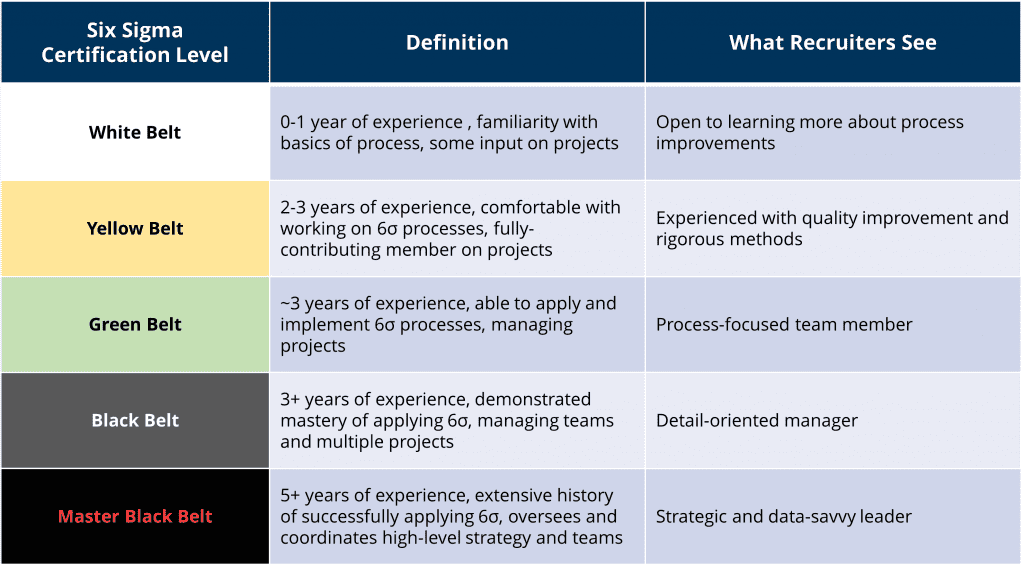
Here at ECA, we use evidence-based processes to place high-quality candidates in roles for our clients. Part of our process includes working closely with these clients to establish what their ideal candidate profile looks like for a given role. The Six Sigma certification can be a key piece of the puzzle for many clients who want a candidate that is detail-oriented, highly organized, analytical, and methodical. From a recruiting perspective, seeing a Six Sigma certification on a resume is a great sign that the candidate may possess many of those desired characteristics. For example, in a recent search for a Chief of Staff at a PE firm, the client mentioned three key requirements for the role:
Based on these requirements, we implemented a search strategy that prioritized sourcing candidates with at least a Green Belt Lean Six Sigma certification and were able to fill the role in under 3 months.
Another important consideration is that Six Sigma and Lean Six Sigma are standards and protocols, and only make sense when put into the context of a production or engineering project. When a candidate has a Six Sigma certification on their resume, this can be a great jumping off point for recruiters to ask about their process for solving difficult production or operational problems. Knowing the language and meaning behind the certification can provide a benchmark for determining whether a candidate’s response to such a question accurately reflects the doctrine of Six Sigma, and whether it was appropriately applied. This can be especially important when applying for roles at organizations that have specific needs around quality control, process improvement, and organizational effectiveness.
Here are some sample questions that recruiters may ask about Six Sigma certifications:
- “Tell me about a time you employed Six Sigma processes in your role to increase efficiency. What was the outcome of employing those processes?”
- “Talk me through how you approach a new project. Be specific with the models, theories, and ideas you like to bring to bear.”
- “Share how you would respond if a leader at your company asked you to reorganize the workflow for your team. What are the first steps you would take? What goals would you set?”
Here are links for additional information and resources related to Six Sigma and Lean Six Sigma:
Detailed Overview of Six Sigma and Lean Six Sigma – American Society of Quality
Six Sigma Certifications and Trainings – SixSigmaOnline.org
“Benefits, Obstacles, and Future of Six Sigma Approach” – Scholarly Article with Case Study Examples
Have a role you'd like to discuss?
Looking to expand your team?
Expertise
Insights
Commentary & Thought Leadership
Evidence Based RecruitingCase StudiesBlogBeyond Consulting PodcastNot So Private Equity Podcast


